

So have you decided to search for a used band instrument for your beginning band student? O.K. Let’s go over some things to look for and cost vs quality.

NAME BRAND
As you begin your search for a used beginning instrument, check with the local music instructor for the brands they recommend. There are a lot of inferior instruments out there that may look fine to start with but are not made well and/or repair parts are impossible to acquire. Knowing what brand names to look for will often eliminate a costly mistake for you and frustration for your beginning student.

There are some instrument manufacturers that build and distribute instruments under a different names. Often these might be distributed at a lower cost, however these also might be not as well built or have fewer options. Check with your local instrumental teacher for specifics and recommendations.

CHECK YOUR LOCAL MUSIC STORE
Before you run to every garage sale in your location, go to your local music store to check their inventory of used instruments. Chances are these instruments will be name brands in good playing condition. Often you may be able to purchase outright or rent to own at a lower cost than a new instrument. Check the difference in cost though. Often, for a few more dollars a month, you can get a new instruement instead of used. However a good quality used instrument from a reputable store might be best for your budget.

ONLINE:
The most important factor to consider when purchasing from an online vendor is this: Warranty and/or Service. Yes the price might be good, but if there is a problem with the instrument you are often on your own. Even if the vendor offers warranty service you may still have to pay shipping to and from the service facility. This may vary depending on the vendor but know before you buy.

Knowing what name brands to look for is vital. I have seen many instrument brands online that I have never heard of and know little about. These might be newer brands that have yet to establish a reputation for quality, but do you want to take that chance?

THERE’S THIS INSTRUMENT IN THE FAMILY………
So you found Great Uncle Fred’s old cornet in the attic and are considering it as a beginning instrument for you child. HAVE IT CHECKED OVER! Take it to your instrumental music teacher or your local repair shop for an evaluation. On rare occasions these can be reconditioned and used with success but often it costs more to get this relic to playing condition than it is worth. Also consider the student using an instrument. Might they consider this instruement an antique as compared to the newer, shiny instrument the other students in their class might be using?


If, however, cousin Sally played her clarinet for only one year and it has been sitting idle for only a couple of years, it might be an option. Again, HAVE IT CHECKED OVER by the band director or a local repair shop.

THINGS TO CHECK WHEN SHOPPING FOR A USED INSTRUMENT
THE CASE:
No matter what instrument you are looking for check out the condition of the case. The exterior should be clean, the latches and hinges are all there and in good working condidition. The interior should be clean, no tears in the interior cover material, signs of mold or mildew or a suspicious odor. Depending on the instrument, check to make sure each instruement part fits snuggly.
Woodwinds will have several sections and each should fit the coresponding section in the case.


Brass instruments generally do not have as many sections. Trumpet, French horn, baritone and tuba cases will have a moulded place in the case for the instrument body and a compartment for the mouthpiece.


The trombone case will have a place for the bell section and the slide. Some trombone cases have the bell section in one section of the case and the slide in the case lid. These parts may have a strap to hold them in place or might “snap” into the case. Whichever design the trombone case has, make sure it is functioning properly to avoid damaging the instrument.


INSTRUMENT BODY:
Woodwinds – Wood or Plastic Body: Clarinet/Oboe/Bassoon
CRACKS and/or OTHER POSSIBLE DEFECTS
No matter the material (plastic or wood) check for visible cracks in the body. If they are visible chances are the crack(s) might render the instrument unplayable. Some cracks can be repaired but could be expensive, especially with a wooden instrument.

One area of a woodwind instrument body, regardless the material, vulnerable to breakage are the tenons, or the part of each body section that fits inside the corresponding body part. These areas are a thinner material and thus, if dropped, can break. These areas should also be covered with a thin cork material to aid a snug fit and prevent leaking air. These corks should be in good condition with no pieces missing. These corks can be replaced by a qualified repairman but will be more expensive as there are more corks. If the tenon is broken it is time to look for another instrument.

Woodwinds – Metal Body: Flute, Saxophone
Dents:
Flutes
Especially check the head joint (the part that the student will blow into) for dents to the part that goes into the body of the flute. If this is difficult to insert into the flute body it is most likely has been dropped and dented.

A similar area susceptible to denting is at the end of the main body where the foot joint is placed. Like the end of the head joint, the metal is thinner here and if dropped it could prevent the foot joint from fitting properly.

SAXOPHONES
The two most vulnerable areas for dents on a saxophone are the bell and the bell bow (where the body curves up to the bell). Dents in these areas are often caused from dropping the instrument. The bell bow is usually reinforced with an extra layer of metal to help with this issue but it isn’t 100% dent proof. If dents in these areas are visible it could also cause misalignment of the large keys on the bell section.

THE NECK:
Like the flute, the saxophone neck has a thinner end that fits into the main body. This is also vulnerable to dents and misshaped from drops. Check the neck for two necessary components:
- The neck should easily fit the top of the saxophone body. If it is out or round or dented it will either not fit at all or will be excessively tight.
- The part of the neck on which the sax mouthpiece is placed should have a sleeve of cork. The cork should not be chipped or torn and should be solidly glued to the neck. If this is the only flaw on the instrument it is a fairly inexpensive fix.

ALL WOODWINDS
PADS
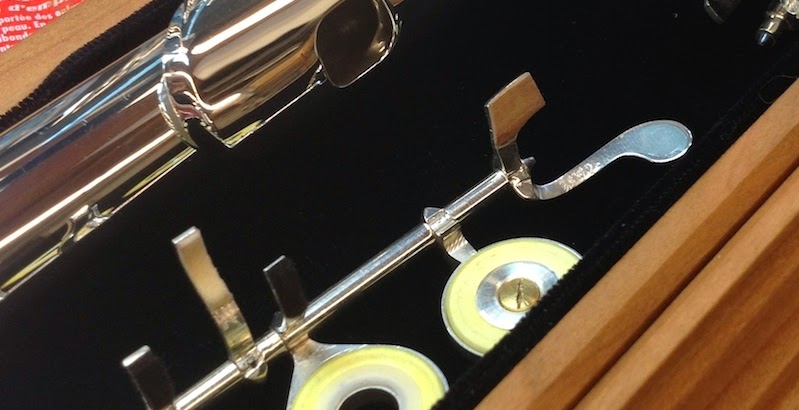
All woodwind instrument have pads that close the holes on the body of the instrument. Check these pads for the following:
- Are they all there? No matter the woodwind instrument, a pad will be fitted into a metal cup-like fitting above an open hole.
- Is the pad covering intact? Flute, Clarinet and Oboe pads are often an off-white color and will have a very thin cover over the felt-like pad material. This thin material can split, break or crack over time and then the pad will leak making it difficult to play. Saxophones may have a tan or brown leather-like covering but check for the same possible problems. IF the used woodwind instrument has been in a closet or attic for a period of time, there could be pieces of the pads missing.

BENT OR BROKEN OR LOOSE KEYS
Most of the time hese can be quite obvious. If you open the case and pieces of the instrument fall off, you have a potential problem. If the keys look like they are in good condition it might just be a case of a missing or loose set screw. It could also be a more serious repair issue. If any are obviously bent or broken keys, time to look at a different used instrument.

CLARINET & SAXOPHONE MOUTHPIECE
Both clarinet and saxophones have a mouthpiece that has a tapered, thinner part that could chip or crack if dropped. Check the tip for these issues. The clarinet mouthpiece should have a small cork ring on the end that fits into the clarinet barrel. This cork should be solid, not torn or chipped.

Accompanying the clarinet or saxophone mouthpiece should be a metal or sometimes plastic ligature that holds the reed on the mouthpiece. If there is no ligature it shouldn’t be a “deal breaker” as these are easily and inexpensively replaced.

BRASS INSTRUMENTS
BODY CONDITION:
With brass instruments the condition of the body and finish will be very obvious. Usually brass instruments are brass or silver plated and have a lacquer finish that helps to protect the shiny metal finish. If the lacquer finish has been affected by a dent or wear and tear, you will see it. Dents will usually be obvious, generally on the bell or curved portions of the tubing. Even if repaired there may still be visible evidence. This is a cosmetic flaw and usually does not affect how the instrument plays.
DENTS
Whereas most dents are cosmetic some may affect the playability of the instrument. Here are a couple of specific things to check for:
Trumpets and Baritones/Euphoniums:
Check the motion of the valves which should be very easy to move up and down. If a valve is difficult to move or goes down but does not come back up there could be a dent in the valve casing (the cylinder in which the valves moves.) This type of dent may not be visually obvious.

French Horns:
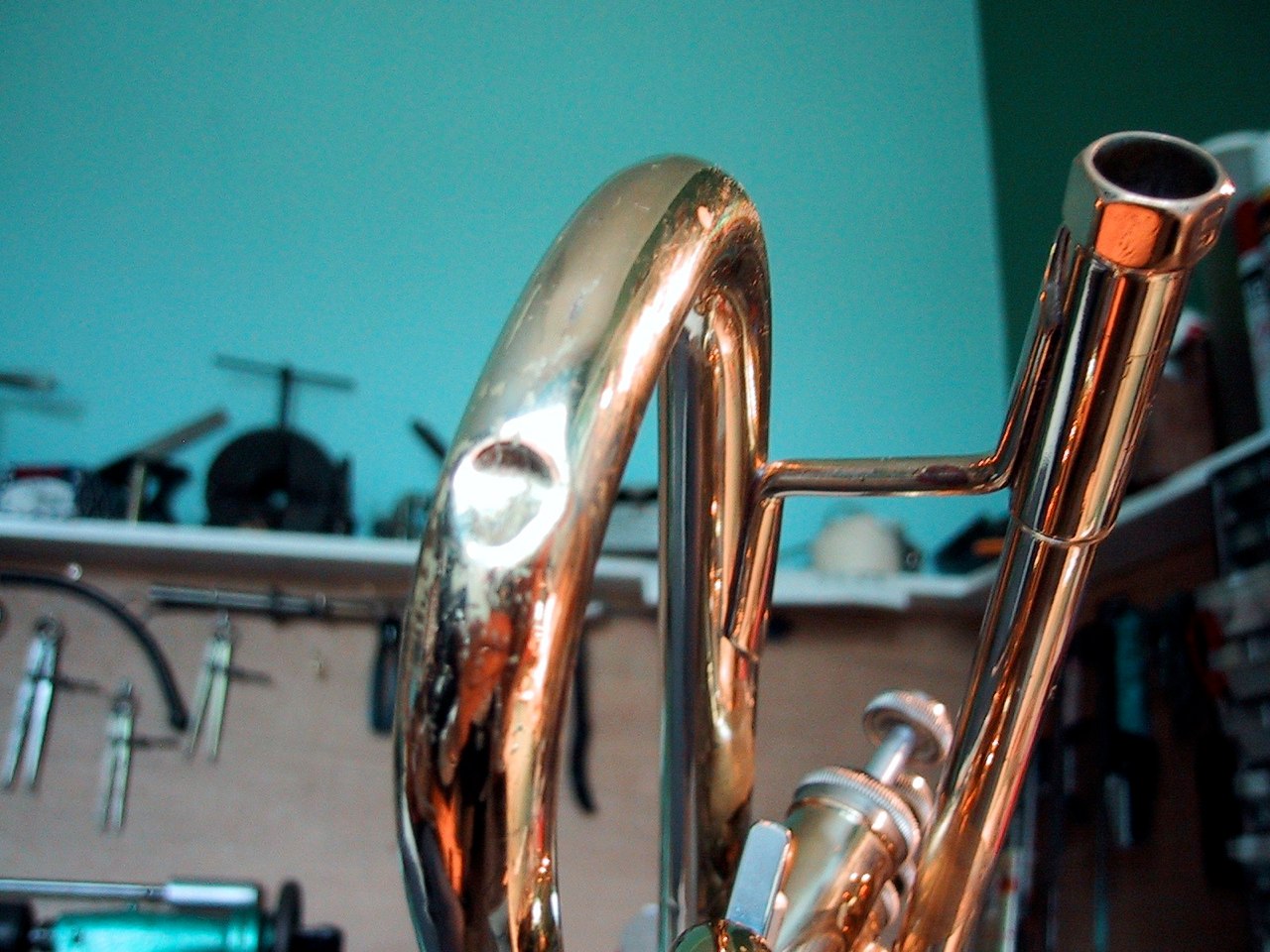
The most prominent (and most vulnerable) feature on the French Horn is the large bell. It will be very evident if this is dented or bent. Though it may not greatly affect the playability of the instrument it will may influence a young player’s attitude toward the instrument. Check the bell for damage and/or repaired damage.

Another unique feature of most French horns is the valves. Unlike trumpets, baritone/euphonium and many tubas, the French horn used rotary valves. Like the other piston valves, these rotary valves should rotate easily using the spatula-type keys. There are two kinds of common design of these rotary valves, one that utilizes a string and another that is a mechanical “linkage” that does not use string. Each has advantages and disadvantages but as long as the valves work well either will work.


Trombones:
Check the motion of the slide. It should be free moving and not scratchy sounding. If there are any dents in the slide you will feel a “catch” or sluggish feeling where the dent is. Usually the slide dents are on the outer slide and are fairly easy to repair by a qualified repair shop.

TUNING SLIDES:
Each brass instrument will have tuning slides. The tuning slide should be functional depending on how long it has been since the instrument has been played. If the tuning slides work, great. If not, a qualified repair shop can easily get them functioning.

WATER KEY (SPIT VALVE)
With the exception of the French horn, all brass instruments will have a valve to empty the accumulated water from the instrument. This water key is usually on the end of the main tuning slide, or in the case of the trombone, the end of the main slide. These valves will have either a cork or neoprene piece that seals the water key from leaking until it is opened. The key should have a spring that keeps it closed until pressed to open it to release the water. Even if the cork or neoprene is missing and the key functions properly it is inexpensive to replace and shouldn’t be a major concern. IF, however, the key has broken off of the instrument, this could be more expensive to repair.


https://en.wikipedia.org/wiki/Water_key
Percussion
Depending on your school’s instrumental music department, a beginning percussion student might have several options. Some schools want all percussionists to start on a mallet instrument like xylophone or orchestra bells. Another possibility would be just using a snare drum or a practice pad, drum sticks. Sometimes the student is instructed to get a beginning drum kit which consists of a snare drum, practice pad, a snare stand (which also might hold the practice pad), and a small set of orchestra bells with a stand.


Before you begin looking for used percussion equipment double check with the band department and their percussion guidelines.
Snare drum
Case: as with woodwinds and brass, the case should be in good condition to protect the snare drum. Snare cases can be made of moled plastic or heavy duty padded nylon. Drum kits or drum/bell kits often are in a rolling case, making it much easier to transport.
Body/finish condition
Most beginning level snare drums will be have a metal shell, usually silver. Unless it has been run over by the school bus these area generally very durable. Snares drums can also have laminated wood shells and can be either stained or covered with a plastic or vinyl colored material.


Size:
Most student snares are 14” in diameter and have 10 – 12 lugs/tension rods (the screw type mechanism that hold the drum head to the drum.) The student snare will usually have 10 lugs.
Heads:
Each snare drum has two heads, a batter head (the top head which is played upon) and the snare head (on the bottom) over which the snares are stretched. You want both of these heads to be in good condition, not torn or dented. These heads are easily replaced though if that is the only problem with the snare drum.
Snares:
On the bottom head will be snares. Usually metal, the snares give the buzzing effect of the snare drum and are fitted so they can be firmly stretched on the bottom head or released to not touch the head for a different effect. The SNARE STRAINER is the mechanism that stretches or releases the snares from the head. This mechanism should work easily and not “hang up.”

I hope these guidelines will assist you in the search for a used band instrument.
——————————————————————————————————————————————————————————————————
I have been developing a series of digital products to help music educators. Though designed to help with remote and distance learning challenges, these have also had success with in-class individual review and drill as well as in-person group lessons. Check out my growing list of offerings on the links below.
https://www.teacherspayteachers.com/Store/Tbmusic
https://wow.boomlearning.com/author/tbmusic
